
 Contact:
 Delivery:
 Payments:
 Return Policy: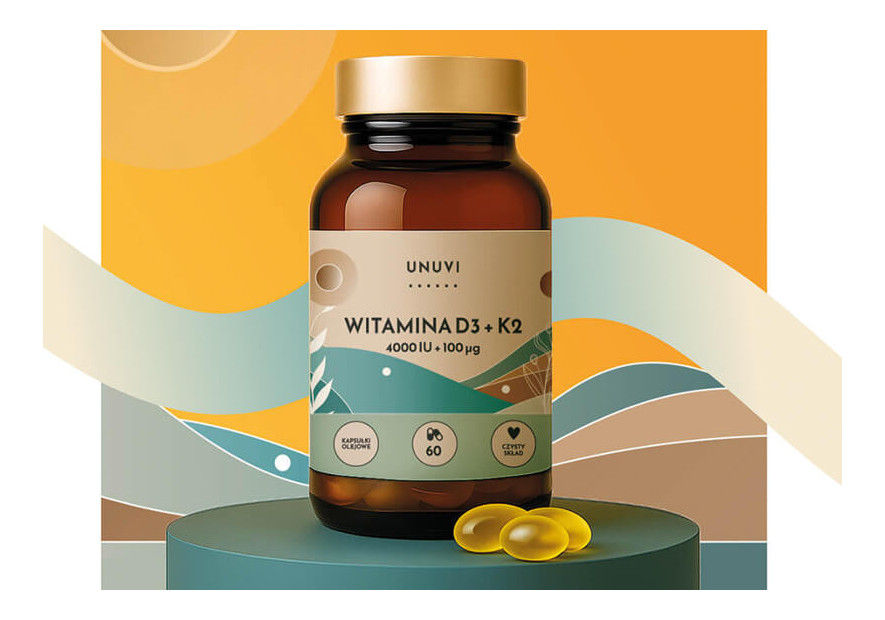

Vitamin D – A Natural Shield for Your Health | UNUVI Blog

Vitamin D, often referred to as the “sunshine vitamin,” is a group of fat-soluble steroid compounds that play a key role in maintaining the overall balance of the body. Although it is most commonly associated with healthy bones, its effects go far beyond the skeletal system. It is one of the most important life-essential nutrients – it supports the functioning of the immune, nervous, and muscular systems, and helps prevent the development of cancer. In the human body, it exists mainly in two forms: D₂ (ergocalciferol) of plant origin, and D₃ (cholecalciferol), which is synthesized in the skin under the influence of UVB radiation and found in animal-derived products.
The role of vitamin D in the body
Skeletal system
Vitamin D increases the absorption of calcium and phosphorus in the intestines, which is essential for proper bone mineralization. Deficiency leads to rickets in children and osteomalacia and osteoporosis in adults.
Immune system
Vitamin D modulates the immune response by affecting the production of cytokines and the activity of T and B lymphocytes. Studies suggest that an adequate level of vitamin D may reduce the risk of viral and bacterial infections.
Nervous system and mental health
Vitamin D deficiency is associated with a higher risk of mood disorders, depression, and neurodegenerative diseases. A study conducted by Professor John McGrath showed that low levels of vitamin D in newborns increase the risk of developing schizophrenia, autism, and ADHD.
Cardiovascular system
Research shows that low levels of vitamin D may increase the risk of hypertension, coronary artery disease, and heart failure. An analysis of data from the UK Biobank found that people with vitamin D deficiency had a 10% higher risk of cardiovascular disease and as much as a 35% higher risk of death due to such diseases.
The scale of vitamin D deficiency in Poland
In Poland, vitamin D deficiency is widespread, especially in the autumn and winter months. Studies indicate that as many as 90–95% of the population may be deficient in this vitamin. The main causes are:
- Limited sun exposure for most of the year
- Low vitamin D content in the daily diet
- Air pollution and wearing clothing that covers the body
Vitamin D level norms and diagnostics
To assess vitamin D levels in the body, a test measuring the concentration of 25-hydroxyvitamin D (25(OH)D) in the blood serum is performed. This is the most reliable indicator of overall vitamin D status because it:
- reflects both endogenous production (in the skin under UVB exposure) and intake from diet and supplements
- has a long half-life (approx. 2–3 weeks)
- is relatively stable over time
Other forms, such as 1,25(OH)₂D – the active form of vitamin D – are not recommended for routine diagnostics, as they may remain within normal limits even in cases of severe 25(OH)D deficiency.
Reference ranges (25(OH)D levels)
| 25(OH)D Level | Value | Clinical significance |
|---|---|---|
| <20 ng/ml | <50 nmol/l | Deficiency – increased risk of osteomalacia, rickets, immune disorders |
| 20–30 ng/ml | 50–75 nmol/l | Insufficient level – supplementation is recommended |
| 30–50 ng/ml | 75–125 nmol/l | Optimal level – recommended range for most of the population |
| >100 ng/ml | >250 nmol/l | Potential toxicity – risk of hypercalcemia, kidney damage |
Who Should Test Their Vitamin D Levels?
Regular monitoring of 25(OH)D levels is especially recommended for people in risk groups:
- people over 60 years of age
- pregnant and breastfeeding women
- individuals with limited sun exposure
- people with obesity (BMI >30)
- individuals with chronic conditions: kidney, liver, intestinal, or thyroid diseases
- patients taking medications that interfere with vitamin D metabolism (e.g., glucocorticoids, antiepileptic drugs)
- people suffering from depression, low mood, or frequent infections
Where to Test Vitamin D Levels?
The test can be done at:
- Diagnostic laboratories throughout Poland. Most labs also offer vitamin test packages including, among others, vitamins D, B12, and folic acid.
- Without a referral – the test is paid out-of-pocket and usually costs between 70 and 120 PLN, depending on the lab.
- From venous blood – the sample is typically taken in a standard manner, either fasting or non-fasting (in most cases, it does not affect the vitamin D result).
How Long Does It Take to Get Results?
The turnaround time for 25(OH)D test results is:
- 24–48 hours in most private laboratories
- in the case of tests ordered by a GP under the National Health Fund (NFZ) in selected cases, the waiting time may be longer and depends on local procedures
What Methods Are Used in Laboratory Analysis?
Depending on the laboratory, various methods are used to determine 25(OH)D concentration:
- Chemiluminescence Immunoassay (CLIA / ECLIA / CMIA) – the most commonly used method in routine diagnostics; fast and inexpensive, but less accurate compared to chromatography.
- HPLC (High-Performance Liquid Chromatography) – a more precise method that distinguishes between D₂ and D₃, but more costly and less widely available.
- LC-MS/MS (Liquid Chromatography–Tandem Mass Spectrometry) – the reference method with the highest accuracy, mainly used in clinical and research settings.
In practical diagnostics, CLIA and ECLIA are sufficient for assessing vitamin D status in most patients.
How Often Should You Repeat the Test?
- Healthy individuals: every 6–12 months, especially after changing the supplement dose or season.
- Individuals with deficiency or chronic diseases: 3–6 months after starting supplementation or treatment.
- After treating a deficiency: follow-up testing 2–3 months after completing therapy.
Supplementation: Recommendations and Safety
Vitamin D is one of the few vitamins whose natural synthesis depends on sunlight. In Poland, due to its geographical location (between 49° and 54° latitude), skin synthesis is effective only from April to September, and only with adequate exposure to UVB radiation. In practice, most of the population does not receive sufficient UV radiation, leading to deficiencies – especially during the autumn and winter months. Therefore, supplementation is recommended not only for people in risk groups but essentially for the general population as well.
Recommended Daily Doses
According to the guidelines of the Expert Group on Vitamin D Supplementation in the Polish population and the position of the Chief Sanitary Inspectorate (GIS), the recommended doses depend on age, body weight, health status, and sunlight exposure:
| Group | Dose (IU/day) | Remarks |
|---|---|---|
| Infants (0–6 months) | 400 | From the first days of life |
| Infants (7–12 months) | 400–600 | Depending on diet |
| Children 1–10 years | 400–1000 | Depending on body weight |
| Adolescents 11–18 years | 800–2000 | Throughout the year |
| Adults 19–65 years | 800–2000 | Depending on body weight |
| People over 65 | 2000–4000 | Reduced skin synthesis |
| Pregnant women | 1500–2000 | After consultation with a doctor |
| People with obesity (BMI >30) | 1600–4000 | Increased demand |
Natural Sources of Vitamin D
Skin Synthesis – Vitamin D from the Sun
The most important natural source of vitamin D is not the diet, but skin synthesis, which occurs in the body under the influence of UVB radiation (290–315 nm). The skin contains a compound called 7-dehydrocholesterol, which is converted into previtamin D3 under UVB rays, and then – under the influence of body heat – into biologically inactive vitamin D3 (cholecalciferol). Next, in the liver and kidneys, vitamin D3 is metabolized into its active forms: 25(OH)D and 1,25(OH)₂D.
It is estimated that about 80–90% of the body’s vitamin D needs can be met through regular sun exposure – provided it occurs consistently and under appropriate climate conditions. Excess vitamin D produced is not toxic – the body breaks it down into inactive compounds.
How Much Time Is Enough to Meet the Requirements?
In Poland, from April to September, just 15–30 minutes of daily skin exposure (bare arms, legs, face – about 18% of body surface) to sunlight between 10:00 a.m. and 3:00 p.m., without sunscreen, is sufficient to meet the daily requirement for vitamin D.
After this time, synthesis stops, and the excess of previtamin D and vitamin D is broken down – thus there is no risk of overdose due to excessive sun exposure.
"Just 15–30 minutes of daily sun exposure between 10:00 a.m. and 3:00 p.m. on uncovered skin during spring and summer is enough." – Holick, 2004
Factors Affecting the Effectiveness of Synthesis
-
Time of Day and Year
- The highest vitamin D production occurs when the sun is high in the sky – between 10 a.m. and 3 p.m.
- In Poland’s geographic latitude, skin synthesis is effective only from April to September. From October to March, the angle of UVB rays is too low to effectively penetrate the atmosphere – even if it’s sunny.
-
Exposed Skin Surface
The more skin is exposed, the more vitamin D is synthesized. The minimum effective area is about 18% of body surface (e.g., face, arms, legs). Exposing the back or abdomen increases synthesis.
- Skin Tone
People with darker skin (more melanin) may require 3–5 times more sun exposure than those with fair skin. Melanin acts as a natural sunscreen and blocks vitamin D synthesis.
-
Use of Sunscreens
Sunscreens with SPF >15 almost completely inhibit vitamin D synthesis by blocking UVB rays. While sun protection is important, especially during prolonged exposure, it is advisable to spend the first 15–20 minutes in the sun without sunscreen (unless contraindicated by dermatological conditions).
-
Age and Body Composition
- In older adults (>65 years), synthesis efficiency drops by up to 75% due to lower levels of 7-dehydrocholesterol in the skin.
- People with obesity have difficulty efficiently utilizing vitamin D – it is stored in fat tissue and less available for metabolic processes.
- Very lean individuals may have lower reserves of 7-dehydrocholesterol, which also negatively affects synthesis.
-
Diseases and Medications
- Liver and kidney diseases, as well as some medications (e.g., antiepileptics – phenytoin, carbamazepine), can impair the conversion of vitamin D into its active forms.
- Sunbathing behind glass (e.g., in a car or indoors) is ineffective – UVB radiation does not penetrate glass.
Diet as a Source of Vitamin D
Vitamin D occurs in the diet in two forms:
- D3 (cholecalciferol) – of animal origin
- D2 (ergocalciferol) – of plant origin
The highest amounts of vitamin D3 are found in fatty sea fish and animal-derived products:
| Food Product | Vitamin D Content (IU/100g) |
|---|---|
| Cod liver oil | ~10,000 |
| Salmon | 600–1000 |
| Herring | 800 |
| Mackerel | 250–350 |
| Egg (yolk) | 40–50 |
| Hard cheese | 20–40 |
| Whole milk | 5–10 |
In Poland, some products are fortified with vitamin D – including milk, margarine, children’s yogurts, and baby cereals.
Vitamin D and Chronic Diseases
Research suggests that adequate vitamin D levels may influence:
- Cancer: Some studies indicate a link between low vitamin D levels and increased risk of colorectal, breast, and prostate cancer.
- Type 2 Diabetes: Vitamin D supplementation may delay the onset of diabetes in predisposed individuals.
- Autoimmune Diseases: Vitamin D deficiency may increase the risk of autoimmune disorders such as multiple sclerosis and Hashimoto’s disease.
Summary: Key Takeaways
- Vitamin D is essential for bone, immune, and nervous system health.
- Vitamin D deficiency is common in Poland, especially during autumn and winter months.
- Regular supplementation and adequate sun exposure are crucial to maintaining optimal levels of vitamin D.
- Before starting supplementation, it’s advisable to consult a doctor and, if possible, test 25(OH)D levels.

Vitamin D3 + K2 MK7 4000 IU 100 mcg 60 softgel capsules UNUVI Vitamin D3 + K2 MK7 4000 IU 100 mcg 60 softgel capsules UNUVI
UNUVI Vitamin D3 + K2...
UNUVI Vitamin D3 + K2 is a premium dietary supplement with 4000 IU vitamin D3 and 100 μg vitamin K2 (MK-7) in oil-based softgel capsules. Intended exclusively for adults over the age of 65. Supports immunity, bone health, and cardiovascular function.
Price zł45.30
UNUVI - Vitamin D3 + K2 4000 IU 100 mcg | 120 capsules UNUVI - Vitamin D3 + K2 4000 IU 100 mcg | 120 capsules
UNUVI Vitamin D3 + K2...
UNUVI Vitamin D3 + K2 is a dietary supplement containing 4000 IU of natural vitamin D3 from lanolin and 100 μg of bioactive vitamin K2 MK-7. Supports immunity, bone health, and cardiovascular function. The synergy of D3 and K2 promotes proper calcium metabolism. Package: 120 capsules.
Price zł45.99
UNUVI - Vitamin D3 + K2 2000 IU 100 mcg | 60 capsules UNUVI - Vitamin D3 + K2 2000 IU 100 mcg | 60 capsules
UNUVI Vitamin D3 + K2...
UNUVI Vitamin D3 + K2 is a dietary supplement containing 2000 IU of natural vitamin D3 from lanolin and 100 μg of bioactive vitamin K2 MK-7. Supports immunity, bone health, and cardiovascular function. Ideal for individuals with vitamin D deficiency or low sun exposure. Package: 60 capsules.
Price zł34.50
UNUVI - Vitamin D3 + K2 2000 IU 100 mcg | 120 capsules UNUVI - Vitamin D3 + K2 2000 IU 100 mcg | 120 capsules
UNUVI Vitamin D3 + K2...
UNUVI Vitamin D3 + K2 is a dietary supplement containing 2000 IU natural vitamin D3 from lanolin and 100 μg bioactive vitamin K2 MK-7. Supports immunity, bone health, and cardiovascular system. Ideal for people with vitamin D deficiency or limited sun exposure. Package: 120 capsules.
Price zł45.00
UNUVI - Vitamin D3 4000 IU | 60 capsules UNUVI - Vitamin D3 4000 IU | 60 capsules
UNUVI Vitamin D3 4000...
UNUVI Vitamin D3 4000 IU is a dietary supplement containing a high dose of natural vitamin D3 from lanolin. Supports immunity, bones, and muscles – ideal for low sun exposure or higher needs. Package: 60 capsules.
Price zł25.99

UNUVI - Vitamin D3 4000 IU | 120 capsules UNUVI - Vitamin D3 4000 IU | 120 capsules
UNUVI Vitamin D3 4000...
UNUVI Vitamin D3 4000 IU is a dietary supplement providing a high dose of natural vitamin D3 from lanolin. Supports immunity, bones, and muscles – perfect during low sun exposure or times of increased need. Package: 120 capsules.
Price zł31.99
Leave a comment